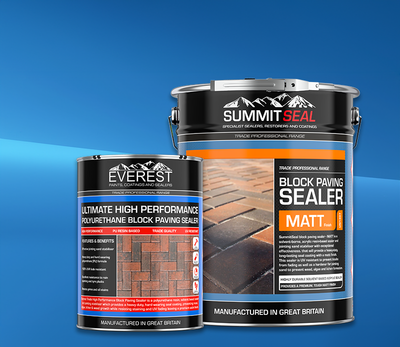

Good-quality industrial floor paint could save you lots of money in the long run - or lose you just as much if you don’t take into account your floor’s specific requirements.
Epoxy & polyurethane floor paints are considered the titans of the industry, but they behave differently under stress. So, which one do you choose? Below, we’ll explore the key features of both, their limitations, and best uses, as well as answer an important question: is a hybrid multicoat necessary?
Epoxy Floor Paint - A Complete Guide
First, we’ll look at epoxy floor paint.
Technically, epoxy is not "paint" in the traditional sense. While paint dries through evaporation, epoxy cures through a chemical reaction. It consists of two parts: a Polyamine Resin and a Catalyst (Hardener). When mixed, they create a cross-linked polymer structure that is incredibly dense. This results in a surface that is much thicker and tougher than any water-based or oil-based floor paint.
Due to this special mechanism, epoxy floor paint benefits from:
✓ High Strength - high-solid epoxies can withstand over 10,000 psi. This means it won't crush or peel under the weight of heavy stationary machinery or massive storage racks.
✓ Concrete Reinforcement - epoxy seeps into the pores of the concrete, making the top layer of the slab stronger and preventing "concrete dusting" (the white powder that often settles on warehouse goods).
✓ Improved Hygiene - epoxy leaves behind no grout lines or seams where bacteria, mould, or hazardous chemicals can hide, making it very easy to power-wash or sanitise.
✓ Versatility - you can add anti-slip aggregates for safety, or decorative flakes for a professional aesthetic.

Due to its properties, epoxy floor paint is best used for:
-
Heavy Manufacturing - areas where heavy steel parts might be dropped or moved.
-
Automotive Garages - where floors need to resist "hot tyre pick-up" (when hot tyres peel the coating off the floor).
-
High-Traffic Areas
However, epoxy does have some limitations as well:
X Moisture Sensitivity - if there is high moisture vapour coming up through the concrete slab, the epoxy can bubble or "delaminate." A moisture test is always required before application.
X Yellowing Effect - epoxy is not UV-stable. If used in a sunlit loading bay, it will eventually turn a yellowish-amber colour and lose its gloss, becoming brittle over time.
X Rigidity - while epoxy is great for impact, it doesn't handle structural building movement well. If the building settles and the concrete cracks, the epoxy will almost certainly crack along with it.
What Is 100% Solids Epoxy Paint
Not just any epoxy paint will do - look for 100% Solids Epoxy Floor Paint.
If a paint has less solids (e.g. 50%), the solvents added will evaporate as the paint dries, leaving the floor coating much thinner than when it first applied. With 100% solids epoxy, 1 litre of paint results in 1 litre of solid plastic - you get exactly what you pay for, with no waste.
100% solids epoxy also has a much higher resin density. This creates a tenacious mechanical bond with the concrete substrate, making sure it doesn't just sit on top but becomes part of the floor. No solvents in the paint also means near-zero VOCs (Volatile Organic Compounds), which is ideal for industrial facilities with strict regulations (e.g. food, beverages, pharma).
The bottom line is - 100% solids epoxy is also much more durable.
-
Standard Paint - may need to be recoated every 1–2 years in a high-traffic zone.
-
100% Solids - can easily last 10+ years with proper maintenance.
If you are simply coating a residential pantry, a water-based epoxy is fine. If you are coating a floor that supports a 5-ton forklift, 100% solids is the only professional choice.
|
Our Top Pick: Everest Trade - HB Epoxy Factory Floor Paint - Industrial Grade - Two-Pack Epoxy Coating |
Our top choice, manufactured for use in factories, warehouses and industrial units.
|

Polyurethane Floor Paint - A Complete Guide
If Epoxy is the primer and build coat, Polyurethane is the high-performance finish.
Polyurethane (PU) is a reactive polymer coating - unlike epoxy, which is thick and rigid, this one is formulated to be thin-film and flexible. It acts like a permanent, high-strength clear coat that sits on top of the floor to take the brunt of daily abuse.
Polyurethane floor paint is preferred in some settings due to its:
✓ UV Stability (Non-Yellowing) - polyurethanes do not degrade or turn yellow when exposed to sunlight.
✓ Scratch & Abrasion Resistance - polyurethane is significantly harder to scratch than epoxy. It has a slicker surface tension that allows pallets and shoes to slide across it without scuffing the finish.
✓ Chemical Resistance - PU is highly resistant to things like brake fluid, jet fuel, and lactic acid (common in food plants).
✓ Flexibility & Thermal Shock - if your facility moves from freezing to hot (like a professional kitchen or a loading bay in winter), PU can expand and contract without cracking or peeling.

Consider using polyurethane for:
-
Aircraft Hangars - due to the UV resistance
-
Commercial Retail
-
Cleanrooms and Labs - where frequent harsh chemical cleaning is required.
-
Top-Coating Epoxy - using PU as a final layer over an epoxy base to provide the best of both worlds.
Just like epoxy, polyurethane on its own does come with a few downsides:
X Thin Application - you cannot use PU to level a floor or fill in cracks. If your concrete is bumpy, PU will show every bump.
X Poor Adhesion to Raw Concrete - polyurethane does not bite into concrete as well as epoxy does. If applied directly to bare concrete without a primer, it is much more likely to flake off.
X Moisture Sensitivity - if there is high humidity while PU is curing, it can cause "foaming" or tiny bubbles to form in the finish.
|
Our Top Pick: Everest Trade - Industrial Concrete Floor Paint |
Our top choice for industrial-grade polyurethane floor paint.
|

Industrial Floor Paints - Key Requirements
There is no “best option” between polyurethane flooring and epoxy. The choice purely depends on your highest priorities and needs. Consider factors such as:
Durability & Heavy Impact
In environments with heavy machinery, steel-wheeled carts, or dropped tools, a thin coating will shatter or peel. You need something to absorb the energy of an impact.
The choice: 100% Solids Epoxy. Its high-build nature (thickness) provides a structural cushion that thin-film coatings simply can't match.
Chemical and Stain Resistance
Industrial floors are often attacked by "aggressive" fluids. Motor oil, hydraulic fluid, or sulfuric acid from batteries can soften a standard floor paint, causing it to become sticky or lift entirely.
The choice: Polyurethane (PU). PU has a tighter molecular structure than epoxy, making it much more resistant to staining. It’s the go-to for labs and hangars.
Weather and UV Stability
If your floor is near large bay doors, skylights, or is partially outdoors, UV rays will break down the chemical bonds of certain resins. This leads to "chalking" (a white powdery residue) and yellowing.
The choice: Polyurethane (PU). PU is inherently UV-stable and acts like a sunscreen for your floor, maintaining the colour and gloss for years.
Thermal Shock & Temperature Swings
In food processing or cold storage, floors often come into contact with hot steam or sub-zero temps. Concrete expands and contracts - if the coating is too rigid, it will snap.
The choice: Multicoat (Hybrid) System. By using a flexible PU topcoat over a stable epoxy base, you create a system that can handle temperature shifts without losing its bond to the concrete.
Slip Resistance & Worker Safety
A smooth resin floor is incredibly slippery when wet or oily. In an industrial setting, this is a massive liability.
The choice: Multicoat (Hybrid) System. The high-build Epoxy layer allows you to broadcast heavy aggregates into the wet resin. The Polyurethane then locks those grains in place so they don't sweep away over time.
Epoxy vs Polyurethane Floor Paint - Which One Should You Choose?
Different industrial settings will have different needs. Our general recommendations are:
Location |
Best Paint |
|
Warehouses & Logistics Hubs |
100% Solids Epoxy |
|
Commercial Kitchens & Food Processing |
Polyurethane |
|
Aircraft Hangars |
Multicoat (Hybrid) System |
|
Pharmaceutical & Cleanrooms |
100% Solids Epoxy |
|
Automotive Workshops |
Multicoat (Hybrid) System |
|
Outdoor Loading Docks & Parking Decks |
Polyurethane |
The Multicoat System - An Epoxy + Polyurethane Approach
As you can see, neither epoxy nor polyurethane is a perfect all-in-one product, which is where a multicoat system comes into play. By layering the two types of paint, you create a floor that is structurally sound from the bottom up and chemically shielded from the top down.
How To Layer Epoxy & PU Floor Paints For The Best Effect
Layer 1: The Primer
Even before the main epoxy layer, use a low-viscosity epoxy primer. It is thin enough to soak into the microscopic pores of the concrete. This is done to prevent bubbles rising from the concrete and to ensure the subsequent thick layers don't peel.
Layer 2: The Epoxy Body Coat
Use 100% Solids Epoxy, applied in a thick layer (usually 10–20 mils). This step helps level out the floor, hides pits or scratches in the concrete, and provides the cushion needed against heavy impacts.
Layer 3: The Polyurethane Topcoat
Once the epoxy has cured, roll a thin layer of Polyurethane over the top. This provides the final UV protection so the epoxy underneath doesn't turn yellow, and creates a hard surface that resists scratches from grit, sand, and sliding pallets.
Ready To Transform Your Space With A Finish That Lasts?
At Premium Paints, we specialise in providing industry-leading epoxy & polyurethane coatings for heavy-duty industrial performance.
Our entire range of Industrial Floor Paints is highly affordable without compromising on the chemical resilience your floors demand. Plus, with a massive range of colours and sizes available, you can achieve a bespoke, professional look regardless of your project's scale.
Explore Quality Epoxy Floor Paints For Heavy-Duty Applications →
Explore Polyurethane Floor Paints For Chemical Labs, Outdoor Use, & More →